Dry January and the Out of Home Campaigns Redefining Alcohol Free Drinking
Dry January Becomes a Cultural Advertising Moment
By 2026, Dry January has become one of the most commercially important moments of the year for alcohol free brands. Participation now reflects a broader cultural shift towards moderation, balance, and more intentional drinking habits. This shift is increasingly visible across cities, where out of home advertising sets the tone for how alcohol-free choices are perceived at the start of the year.
January routines bring people back onto public transport, into offices, and through city centres. These everyday movements create the perfect conditions for out of home advertising to deliver repeated exposure at a time when audiences are actively reassessing habits formed over Christmas.
The London Underground as the Heart of Dry January Visibility
For alcohol free brands looking to make a cultural statement, the London Underground has become the most powerful platform during Dry January. Long dwell times, habitual journeys, and enormous daily footfall allow brands to embed themselves into commuter life rather than simply interrupt it.
Heineken 0.0 has used this environment to normalise alcohol free beer at scale. Alongside widespread use of digital panels, cross-track posters, and platform formats across high-traffic stations, the brand delivered one of the most talked-about Underground activations of recent years by temporarily renaming Bakerloo line signage to “Bakerl0.0.” The execution blended into Transport for London’s visual language, creating a moment of recognition rather than overt advertising.
The activation reinforced a simple idea. Alcohol free beer fits into everyday life, including work nights, commuting, and January routines. By appearing consistently across the Underground network, Heineken 0.0 built familiarity and legitimacy at a moment when consumers were actively reconsidering their relationship with alcohol.
DASH Water took a different creative route but used the same Underground dominance to its advantage. Its “Dry? Hardly” campaign appeared across Tube posters and digital formats, using bold colour blocking and playful typography to stand out in busy stations. The messaging rejected the seriousness often associated with Dry January, reframing the month as something light, social, and uncomplicated.
The combination of strong visual language and concise copy meant the campaign landed instantly, even in high-traffic environments. By repeatedly meeting commuters underground, DASH positioned itself as confident, irreverent, and entirely comfortable within the Dry January conversation.
Aqua Pura and Large-Format Humour in Manchester
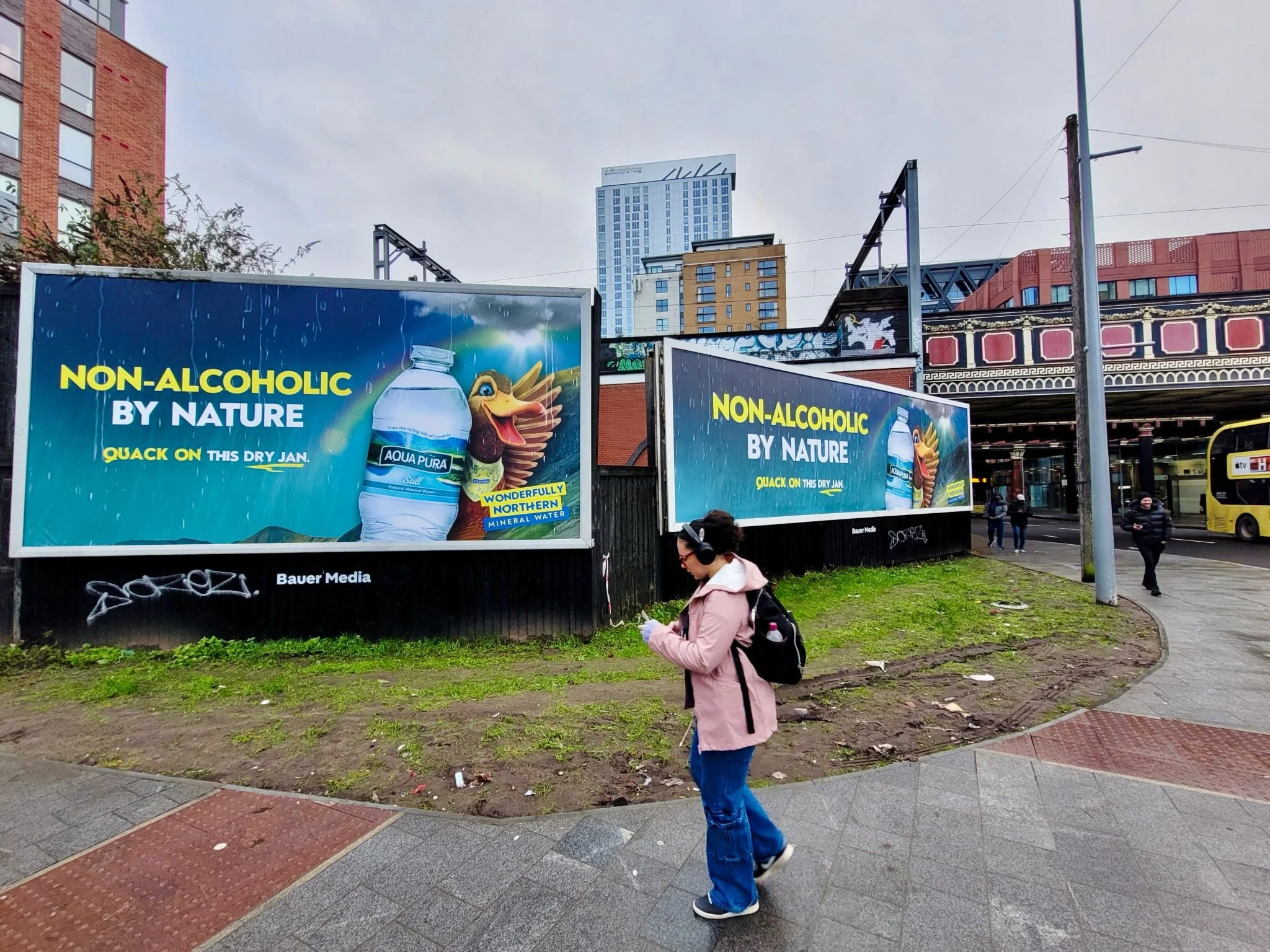
In Manchester, Aqua Pura demonstrated how regional out of home can deliver just as much cultural impact during Dry January. The brand leaned into large 48-sheet billboards positioned on major approach roads and arterial routes into the city, targeting drivers and bus passengers returning to routine after the festive period.
The creative used humour at scale, with oversized copy joking that Aqua Pura has always naturally been alcohol free. The simplicity of the message, combined with the sheer size of the format, made the campaign instantly legible and disarming. Rather than chasing the alcohol-free trend, the brand positioned itself as having quietly met the brief all along.
The use of 48-sheets allowed the copy to breathe, ensuring it worked at speed and felt confident rather than crowded. This approach anchored Aqua Pura as an everyday, no-nonsense choice during January, grounded in local visibility rather than national spectacle.
Why Format and Context Matter in January
What links these campaigns is a deep understanding of environment. The Underground offers long dwell times and repeated exposure. Large roadside billboards capture attention during routine commutes. Bus routes and shelters extend messaging into neighbourhoods, reinforcing the idea that alcohol free choices are not performative or temporary. Increasingly, brands are also exploring airport advertising to reach high-intent travellers during January, when lifestyle resets and international movement intersect.
Dry January 2026 shows a clear move away from worthy detox narratives. Instead, brands are using out of home advertising to reflect real moods, acknowledge January fatigue, and speak with confidence and humour. Format choice has become as important as creative tone in delivering authenticity.
What Advertisers Can Learn From Dry January 2026
The most effective Dry January out of home campaigns succeed because they feel present without being preachy. They rely on cultural awareness, repetition, and simplicity rather than persuasion. By dominating environments like the London Underground or investing in high-impact regional formats, brands build trust at exactly the moment audiences are most open to change.
As Dry January continues to mature, out of home advertising remains one of the most effective ways for alcohol free brands to embed themselves into everyday life. In 2026, the strongest campaigns are not asking people to give something up. They are showing them that moderation already belongs in the spaces they move through every day.